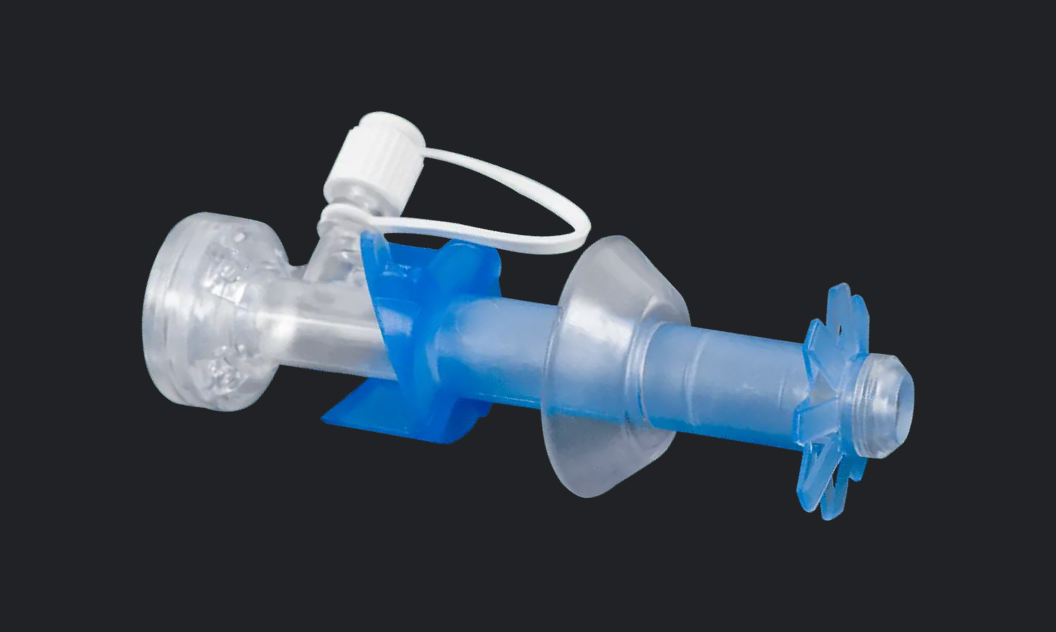
An arthroscopic cannula that expands inside the joint to anchor itself in place — solving a problem surgeons had fought for years. Manufactured by Arthrex and used in operating rooms globally.
Who We Worked With
Arthrex, Strathmore Industries
Partners
Dr. Tom Lyon, Frankie Day-Lyon
Services
Product & Experience
Project Fun Fact
Manufactured and distributed by Arthrex globally
A surgeon got tired of fighting his own instruments. So he invented a better one.
During arthroscopic shoulder surgery, surgeons work through a cannula — a small tube inserted through a tiny incision that gives them access to the joint. The problem: traditional cannulas don’t stay put. Move an instrument, and the cannula shifts. Tissue obstructs the view. Tools are hard to pass through. Every time it slips, the surgeon loses time, visibility, and precision — in a space measured in millimeters.
Dr. Tom Lyon, Director of Trauma at NYU Langone Brooklyn and a consulting partner with Partners in Design, had dealt with this frustration for years. So he designed his way out of it.
The Expanula is an arthroscopic cannula that expands once it’s inside the target area — functioning like an umbrella that opens beneath the deltoid to anchor itself in place. The outer sheath rotates to expand the distal end, creating a stable portal that holds its position while instruments are inserted, removed, and swapped. When the procedure is done, it closes back up and comes out through the same small incision. Tiny entry. Total stability. Clear view throughout.
The device is manufactured and distributed by Arthrex, one of the largest orthopedic medical device companies in the world, and is used in arthroscopic rotator cuff repairs in operating rooms globally.
The Expanula represents one piece of a much larger medical device design capability within Partners in Design. Dr. Lyon, working with his son Frank Day-Lyon, holds multiple patents for orthopedic devices through Strathmore Industries, has consulted on the design of entire plating systems for surgical startups in California, and has worked with companies including Stryker on device development. His expertise sits at the intersection of clinical practice and product design — he’s not advising from a desk, he’s inventing from the operating room.
For Partners in Design, this means something specific: when we take on a healthcare challenge, we bring the perspective of people who have designed devices that are in active clinical use. Not concepts. Not prototypes on a shelf. Tools that surgeons reach for every day.